Assistant Professor
Email:
shadman.khan@uoguelph.ca
Phone number:
(519) 824-4120 ext. 53803
Office:
Alexander Hall 217
Lab:
Alexander Hall 128, 131, and 214
Website links:
Pronouns:
he/him
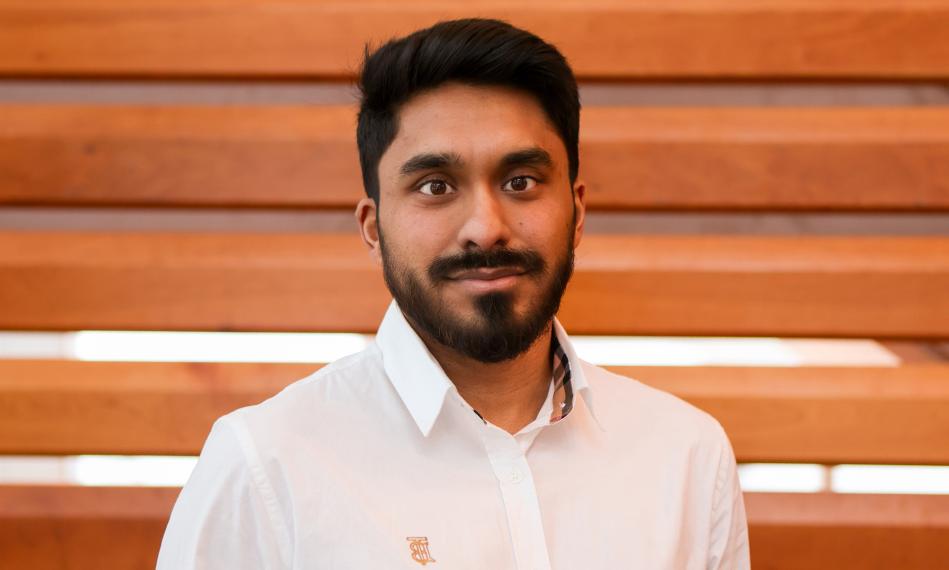
Shadman Khan is an interdisciplinary researcher developing next-generation sensing technologies to detect contaminants and quality markers across complex environmental systems. His work combines smart materials, advanced biosensing molecules, and deployable platform designs to enable more effective monitoring beyond traditional laboratory settings. His research integrates biochemistry, materials science, and environmental analysis towards applications in water, food, and broader environmental contexts. Through interdisciplinary and industry collaborations, his work has helped advance the translation of emerging sensing technologies into applied monitoring and risk assessment strategies.
Dr. Shadman Khan’s research has advanced how microbial contamination is detected across environmental and agri-food systems. He has developed smart sensing materials and practical detection platforms capable of identifying harmful pathogens directly within complex real-world environments such as water and food. These innovations include microneedle-enabled sample-and-sense systems, colorimetric rapid tests designed for untrained use, and in situ monitoring technologies that allow contamination to be detected without specialized equipment.
Through academic and industry collaborations, several of these patented technologies have progressed towards real-world deployment. Collectively, they work to shift detection from centralized testing towards on-site awareness, improving how contamination risks can be recognized and managed. Shadman’s current work focuses on creating next-generation sensing platforms that offer greater sensing capabilities and improved environmental resilience.
Conventional testing often requires centralized laboratories and delayed results. This project develops low-cost, portable biosensors for the rapid detection of microbial contamination in environmental waters. Using smart materials and next-generation sensing elements, these systems provide visual or smartphone-readable results without laboratory infrastructure, enabling decentralized monitoring and faster decision-making.
Periodic sampling can miss short-lived contamination events that pose real risks. This project designs sensing platforms that continuously track microbial and chemical contamination within environmental waters. By capturing transient changes in real-time, these systems aim to provide reliable insight through environmentally resilient materials and adaptive signal interpretation.
Many detection tools cannot distinguish between harmless remnants and viable pathogens. This project explores bacteriophage-integrated materials that selectively recognize living microbes and generate measurable signals upon detection. These living systems combine biological specificity with engineered materials to enable responsive sensing and pathogen neutralization.
Sensors deployed in real environments often fail due to fouling and instability. This project develops environmentally responsive polymers that improve durability and performance in complex deployment conditions. By resisting fouling and adapting to environmental stressors, these materials support stable, real-world sensing applications.
Shadman is committed to fostering a supportive and engaging environment where graduate students are empowered to grow as independent thinkers and problem-solvers. His mentorship focuses on helping students shape their own research trajectories, while providing steady support through regular discussions on progress, challenges, and direction. He places strong emphasis on translational research, encouraging students to connect their work to real-world applications and broader societal impact. Through this approach, trainees gain not only technical expertise but also experience in applying their work beyond the laboratory.
Prospective students interested in joining the group are encouraged to visit the lab website for current opportunities and reach out if their interests align. As part of the Canada Excellence Research Chair in Waterborne Pathogens program, trainees work within an interdisciplinary community of students, postdoctoral fellows, and staff, yielding diverse learning experiences and a highly collaborative research environment.
For a full list of publications, refer to Shadman's Google Scholar Profile.